Armand
Interview with the VampireArmand is the auburn-haired vampire who first appears to Louis as a silent rescuer and then becomes the most intellectually formidable figure in the Théâtre des Vampires. He embodies the knowledge Louis has crossed the Atlantic and traveled through eastern Europe to find, but he also exposes the limits of that quest. Armand can explain the vampire’s isolation, challenge Louis’s religious fantasies, and perceive the hidden structure of Louis’s attachments; he cannot provide the mercy, moral certainty, or absolution that Louis wants. His importance therefore lies in the contradiction he represents: ancient wisdom without salvation, intimacy without rescue, and power constrained by a chosen passivity.
Introduction and First Contact
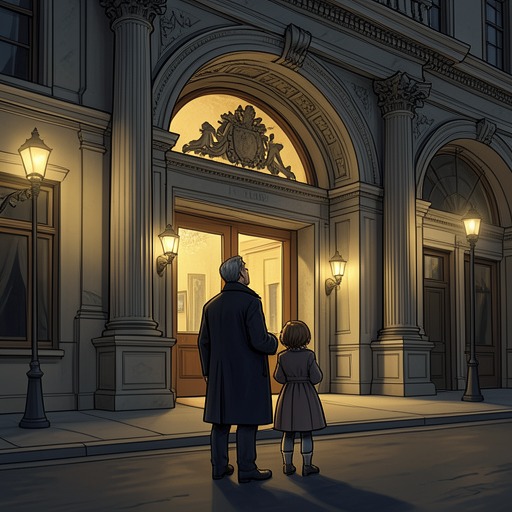
Armand enters Louis’s story in Paris under conditions of danger and theatrical concealment. After another vampire attacks Louis in a narrow street, Armand intervenes decisively, forcing the assailant to relinquish him. He then remains crouched against the wall, nearly motionless, and tells Louis that he is all right. His manner is so still and controlled that he seems part of the architecture rather than a creature moving through it. Without appearing to cross the intervening space normally, he places a white card in Louis’s hand and invites him to the Théâtre des Vampires, promising that neither he nor the other vampire will harm Louis.
The invitation establishes Armand’s authority before Louis knows his name. The card identifies the theater as a place of revelation and bears a second instruction: Louis should bring Claudia, the “petite beauty.” Armand has already learned enough about his visitors to address the bond between them, and his invitation is not merely social. He is drawing Louis and Claudia into the hidden institution over which he possesses decisive influence. The encounter also introduces the contrast that governs Armand’s characterization: the theater presents vampires as performers before a human audience, while Armand himself remains a watcher who controls the boundary between staged illusion and actual predation.
When Louis and Claudia attend the theater, Armand is first encountered through performance. The troupe stages Death in a painted forest, with a scythe, a skull mask, music, and a mortal woman surrounded by seven vampires. The audience responds with gasps, laughter, sighs, and applause, treating the killing as entertainment even as the performers enact the real consumption of a human victim. Armand is not simply one member of this spectacle. He is the detached auburn-haired vampire who earlier confronted Louis, and his presence connects the theater’s public artifice with its hidden violence. The performance turns death into a repeatable cultural form, while Armand’s position behind it reveals that the theater’s greatest illusion is the audience’s belief that it is watching fiction.
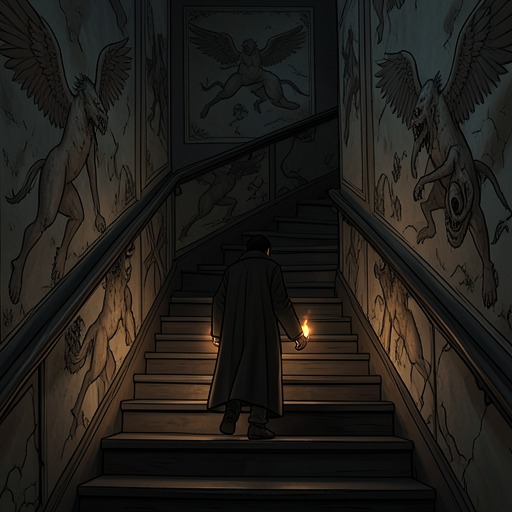
After the performance, Armand leads Louis and Claudia below the theater into an ancient subterranean ballroom and then into rooms decorated with immense murals of death and damnation, including Breughel’s Triumph of Death and The Fall of the Angels. The descent makes the theater’s backstage world appear older and more permanent than the building above. It also gives Armand a setting in which spectacle becomes philosophy: the masks, painted devils, skeletons, coffins, books, and candles are not ornaments alone but images through which Louis tries to understand his own condition.
Identity, Authority, and Philosophy
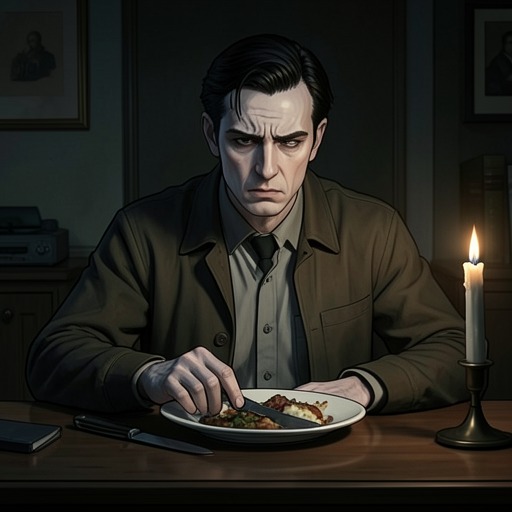
Armand introduces himself plainly and states that he sent Santiago to deliver the invitation. He knows Louis and Claudia’s names and welcomes them to his house. Asked whether he leads the Parisian vampires, he refuses the ordinary meaning of leadership but admits that, if the group has a leader, it is he. This formulation captures his political position. He does not necessarily govern through visible commands, yet the others fear him, defer to him, and recognize his superior power. His authority is both institutional and personal, exercised through stillness, knowledge, and the expectation that he could intervene if he chose.
Louis initially approaches Armand as the answer to a long intellectual and spiritual search. He and Claudia have traveled through Transylvania, Hungary, Bulgaria, and the Carpathians seeking vampires who might explain their origins, only to find mindless corpses and legends emptied of wisdom. Those encounters deepen Louis’s despair. Armand, by contrast, has lived for four hundred years and declares himself the oldest living vampire he knows. The statement destroys Louis’s hope that age must lead to revelation. Armand is ancient, but age has not brought him evidence of God, the devil, or a supernatural moral order.
Armand tells Louis that no vampire he has known has conversed with God or the devil. When Louis asks whether satanic power grants vampires their abilities, Armand rejects the premise and treats the devil in the mural as only a picture. His central argument is that the vampire’s idea of evil comes from disappointment and bitterness, not from literal Children of Satan or Children of God. The only real power, in his account, exists inside the self. This answer does not comfort Louis. It strips away the explanatory myths that have allowed him to imagine his violence as part of a cosmic contest and leaves him alone with his own choices.
Armand’s philosophy is therefore less a doctrine than a refusal of inherited explanations. He will not let Louis turn vampirism into evidence of divine punishment or infernal election. Yet this rejection also has an austere cost. If there is no higher authority, then neither God nor the devil can judge or redeem the vampire; the individual must confront the consequences of desire, killing, and survival without metaphysical assistance. Armand’s calm gives this position unusual force, but his calm does not make it humane. It is the composure of someone who has endured centuries by discarding the questions that still torment Louis.
Relationship with Louis and Claudia
Louis is drawn to Armand with an intensity that exceeds ordinary intellectual admiration. Armand’s face appears young but infinitely old, his voice measured, and his movements free of the habitual gestures rooted in human necessity. Louis feels himself drifting into Armand’s contemplative state and must exert effort to return to his own thoughts. Armand’s listening is equally disarming: he does not seize on pauses, interrupt unfinished ideas, or force a premature interpretation. He allows Louis’s speech to develop, and this attention makes Louis feel both understood and exposed.
Their intimacy becomes explicit when Armand tells Louis that he wants him more than anything in the world. He recognizes that Louis remains bound to Claudia even after Madeleine has entered their household, and he interprets Louis’s attachment as fear of isolation and of losing the only living companion who shares his era. Armand sees Claudia as an entire period of Louis’s existence, a relationship whose end would threaten to make immortal life unbearably vast and empty. He also suggests that vampires who cannot survive the passing of such eras eventually die, which helps explain why he has become the oldest living vampire.
Louis rejects Armand’s implication that Claudia is his paramour and describes her instead as his child. He does not know whether the child can release the parent or whether their bond must last as long as either survives. Armand’s desire thus meets a relationship Louis cannot simply abandon, even though he admits that Claudia is increasingly distant from him. The result is a pursuit-and-withdrawal pattern: Armand offers absolute personal attachment, while Louis approaches him through questions, retreats behind responsibility for Claudia, and remains uncertain whether he wants companionship, knowledge, or escape from the burden of both.
Claudia understands Armand differently. During his conversation with Louis, she remains largely silent, observing him and learning from him. Armand and Claudia exchange a preternatural stillness that excludes Louis, and Louis recognizes that Claudia does not share his concept of evil. Armand’s attention therefore gives form to a division already present within Louis’s household. Claudia seeks knowledge and communion with her own kind without accepting Louis’s moral framework, while Armand recognizes this difference immediately. His relation to Claudia is never simply paternal or hostile; it is shaped by recognition of her unusual nature and by his awareness that she cannot be contained by Louis’s explanations.
The Theater, Passivity, and Conflict
Armand’s greatest moral failure is connected to the Théâtre des Vampires. After Claudia and Madeleine are judged by the theater’s vampires, their bodies are left in the institution’s destructive process, and Louis holds Armand responsible for allowing the execution to occur. Armand insists that he could not have prevented it. Louis rejects that claim, arguing that Armand was the leader, that the others feared him, and that his understanding surpassed theirs. The conflict is not over whether Armand possessed power; it is over whether he was willing to violate his own conception of truth and use it.
Louis sees in Armand a reflection of his own passivity. He accuses him of preserving a fractured morality through refusal to compromise, allowing evil to multiply while treating inaction as principle. Louis connects Armand’s failure to his own earlier failures: he allowed himself to become a vampire despite knowing the act was wrong, allowed Claudia to become one, stood aside while she killed Lestat, and created Madeleine though he knew he should not. Armand’s passivity becomes the external counterpart of Louis’s self-condemnation. The older vampire did not merely fail to save Claudia and Madeleine; he forced Louis to recognize how moral paralysis can present itself as integrity.
Armand’s sadness after the execution does not erase his responsibility. He appears nearly defeated and offers little resistance to Louis’s anger, but his grief is also bound to detachment. Louis believes Armand could have stopped the others if he had used his power beyond his self-prescribed limits. Armand’s tragedy is that he understands the violence of the theater and yet remains within its order until the damage is complete. His authority is real enough to make his inaction a choice, even if he experiences that choice as a limit he cannot cross.
Departure, Revelation, and Ending
After Claudia and Madeleine are destroyed, Armand helps Louis survive the immediate aftermath, but their relationship cannot return to its earlier promise. Louis leaves Paris with Armand and chooses Egypt, seeking the desert, the pyramids, the graves of kings, and the knowledge of grave-thieves rather than the European vampires who have failed him. Before departing, Louis revisits the Hôtel Saint-Gabriel and considers preparing graves for Claudia and Madeleine in Montmartre Cemetery, but he abandons the task. Their belongings remain arranged as though they might return, including Madeleine’s embroidery ring and thread. The objects make absence concrete, while Louis’s refusal to bury them shows that mourning has become inseparable from his rejection of the world that produced their deaths.
Armand later conceals a decisive fact from Louis: Lestat did not die in the Théâtre des Vampires. Two vampires made by the same master helped Lestat secure passage to New Orleans. Armand says that he withheld the information to protect Louis from undertaking a journey driven by revenge, but the concealment also demonstrates the asymmetry of their relationship. Armand decides which truths Louis can bear, acting as protector and manipulator at once. Once Louis learns that Lestat survives, the old bond reawakens, and he and Armand return to New Orleans.
In New Orleans, Armand’s presence becomes temporary and increasingly tenuous. He accompanies Louis through the changed city, past the old house on Rue Royale and the memories of Lestat and Claudia, but Louis’s return is ultimately directed toward Lestat and toward the unresolved past rather than toward Armand. Armand eventually leaves Louis beside the river. Louis does not understand immediately that the departure is permanent; several nights pass before he realizes that Armand has not returned to his coffin. The coffin remains as a material remnant of a relationship whose living presence has withdrawn.
Louis first places Armand’s coffin in the crypt beside his own in the St. Louis Cemetery, then grows uncomfortable with the gesture and removes it, breaking it into pieces and abandoning them in the cemetery grass. The destruction reverses the conventional function of a grave. Instead of preserving Armand as part of Louis’s immortal household, it marks Louis’s refusal to maintain even the object that could represent their union. Armand’s disappearance is thus both a separation and a final judgment on the limits of their intimacy.
Armand’s narrative role culminates in the failure of his promise to supply meaning. He can expose the weakness of religious explanations, recognize Louis’s emotional patterns, and offer himself as a companion, but he cannot transform vampirism into a condition compatible with goodness. Louis finally understands Armand not as a savior but as another destroyer, more ruthless and cunning, whose beauty and lack of regret had once seemed like the escape Louis wanted. Armand’s departure leaves Louis with the knowledge that love between vampires is possible, but that love does not cancel their violence or restore the moral world they have lost.